I finally put the finishing touches on the rough draft of Working Effectively with Unit Tests. It's been an interesting journey thus far, and I'm hoping the attention to detail I've put into the rough draft will translate into an enjoyable read.
What I did poorly: I'd written the book's sample before I ever put it on leanpub. Before a book is published you can collect contact and price information from those who are interested. However, once you publish and begin selling, you no longer have the ability to collect the previously mentioned information. I published and began selling my book immediately - and forfeited my chance to collect that information.
What I did well: I published early and often. I can't say enough nice things about leanpub. I've gotten tons of feedback on example style, writing style, typos, and content. One reader's suggestion to switch to Kevlin Henney's Java formatting style made my book enjoyable to read on a Kindle. I had twitter followers apologizing for "being pedantic and pointing out typos", and I couldn't have been happier to get the feedback. Each typo I fix makes the book more enjoyable for everyone. If you're going to write a book, get it on leanpub asap and start interacting with your audience.
What I learned from Refactoring: Ruby Edition (RRE): RRE contains errors, far too many errors. I vowed to find a better way this time around, and I'm very happy with the results. Every example test in the book can be run, and uses classes also shown in the book. However, writing about tests is a bit tricky: sometimes "failure" is the outcome you're looking to document. Therefore, I couldn't simply write tests for everything. Instead I piped the output to files and used them as example output in the book, but also as verification that what failed once continued to fail in the future (and vice versa). WEwUT has a script that runs every test from the book and overwrites the output files. If the output files are unchanged, I know all the passing examples are still correctly passing, and all the failing examples are still correctly failing. In a way, git diff became my test suite output. I'm confident in all the code found in WEwUT, and happy to be able to say it's all "tested".
What's unclear: Using leanpub was great, but I'm not really sure how to get the word out any further at this point. I set up a goodreads.com page and many friends have been kind enough to tweet about it, but I don't really have any other ideas at this point. I've reached out to a few publishers to see about creating a paperback, and I suspect a print version will increase interest. Still, I can't help thinking there's something else I should be doing between now and paperback launch.
What's next: The rough draft is 100% complete, but I expect to continue to get feedback over the next month or so. As long as the feedback is coming in, I'll be doing updates and publishing new versions.
If you've already bought the book, thank you for the support. It takes 10 seconds to get a pdf of any book you want these days, and I can't thank you enough for monetarily supporting all the effort I've put into WEwUT. If you haven't bought the book, you're welcome to give the sample a read for free. I hope you'll find it enjoyable, and I would gladly accept any feedback you're willing to provide.
Monday, June 30, 2014


Wednesday, May 21, 2014
Working Effectively with Unit Tests
Unit Testing has moved from fringe to mainstream, which is a great thing. Unfortunately, as a side effect developers are creating mountains of unmaintainable tests. I've been fighting the maintenance battle pretty aggressively for years, and I've decided to write a book that captures what I believe is the most effective way to test.
I'm currently ~25% done with the book, and it's available now for $14.99. My plan is to raise the price to $19.99 when I'm 50% done, and $24.99 when I'm 75% done. Leanpub offers my book with 100% Happiness Guarantee: Within 45 days of purchase you can get a 100% refund on any Leanpub purchase, in two clicks. Therefore, if you find the above or the free sample interesting, you might want to buy it now and save a few bucks.
Buy Now here: https://leanpub.com/wewut
From the PrefaceThe book does touch on some theory and definition, but the main purpose is to show you how to take tests that are causing you pain and turn them into tests that you're happy to work with.
Over a dozen years ago I read Refactoring for the first time; it immediately became my bible. While Refactoring isn’t about testing, it explicitly states: If you want to refactor, the essential precondition is having solid tests. At that time, if Refactoring deemed it necessary, I unquestionably complied. That was the beginning of my quest to create productive unit tests.
Throughout the 12+ years that followed reading Refactoring I made many mistakes, learned countless lessons, and developed a set of guidelines that I believe make unit testing a productive use of programmer time. This book provides a single place to examine those mistakes, pass on the lessons learned, and provide direction for those that want to test in a way that I’ve found to be the most productive.
For example, the book demonstrates how to go from...As of right now, you can read the first 2 chapters for free at https://leanpub.com/wewut/read
looping test with many (built elsewhere) collaborators
.. to individual tests that expect literals, limit scope, explicitly define collaborators, and focus on readability
.. to fine-grained tests that focus on testing a single responsibility, are resistant to cascading failures, and provide no friction for those practicing ruthless Refactoring.

I'm currently ~25% done with the book, and it's available now for $14.99. My plan is to raise the price to $19.99 when I'm 50% done, and $24.99 when I'm 75% done. Leanpub offers my book with 100% Happiness Guarantee: Within 45 days of purchase you can get a 100% refund on any Leanpub purchase, in two clicks. Therefore, if you find the above or the free sample interesting, you might want to buy it now and save a few bucks.
Buy Now here: https://leanpub.com/wewut
Monday, May 19, 2014
Weighing in on Long Live Testing
DHH recently wrote a provocative piece that gave some views into how he does and doesn't test these days. While I don't think I agree with him completely, I applaud his willingness to speak out against TDD dogma. I've written publicly about not buying the pair-programming dogma, but I hadn't previously been brave enough to admit that I no longer TDD the vast majority of the time.
The truth is, I haven't been dogmatic about TDD in quite some time. Over 6 years ago I was on a ThoughtWorks project where I couldn't think of a single good reason to TDD the code I was working on. To be honest, there weren't really any reasons that motivated me to write tests at all. We were working on a fairly simple, internal application. They wanted software as fast as they could possibly get it, and didn't care if it crashed fairly often. We kept everything simple, manually tested new features through the UI, and kept our customer's very happy.
There were plenty of reasons that we could have written tests. Reasons that I expect people will want to yell at me right now. To me, that's actually the interesting, and missing part, of the latest debate on TDD. I don't see people asking: Why are we writing this test? Is TDD good or bad? That depends; TDD is just a tool, and often the individual is the determining factor when it comes to how effective a tool is. If we start asking "Why?", it's possible to see how TDD could be good for some people, and bad for DHH.
I've been quietly writing a book on Working Effectively with Unit Tests, and I'll have to admit that it was really, really hard not to jump into the conversation with some of the content I've recently written. Specifically, I think this paragraph from the Preface could go a long way to helping people understand an opposing argument.
I find myself doing both. Different development activities often require different tools; i.e. Depending on what I'm doing, different motivators apply, and what tests I write change (hopefully) appropriately.
To be honest, if you look at your tests in the context of the motivators above, that's probably all you need to help you determine whether or not your tests are making you more or less effective. However, if you want more info on what I'm describing, you can pick up the earliest version of my upcoming book. (cheaply, with a full refund guarantee)
The truth is, I haven't been dogmatic about TDD in quite some time. Over 6 years ago I was on a ThoughtWorks project where I couldn't think of a single good reason to TDD the code I was working on. To be honest, there weren't really any reasons that motivated me to write tests at all. We were working on a fairly simple, internal application. They wanted software as fast as they could possibly get it, and didn't care if it crashed fairly often. We kept everything simple, manually tested new features through the UI, and kept our customer's very happy.
There were plenty of reasons that we could have written tests. Reasons that I expect people will want to yell at me right now. To me, that's actually the interesting, and missing part, of the latest debate on TDD. I don't see people asking: Why are we writing this test? Is TDD good or bad? That depends; TDD is just a tool, and often the individual is the determining factor when it comes to how effective a tool is. If we start asking "Why?", it's possible to see how TDD could be good for some people, and bad for DHH.
I've been quietly writing a book on Working Effectively with Unit Tests, and I'll have to admit that it was really, really hard not to jump into the conversation with some of the content I've recently written. Specifically, I think this paragraph from the Preface could go a long way to helping people understand an opposing argument.
I don't actually know what motivates DHH to test, but if we assumed he cares about validating the system, preventing future regressions, and enabling refactoring (exclusively) then there truly is no reason to TDD. That doesn't mean you shouldn't; it just means, given what he values and how he works, TDD isn't valuable to him. Of course, conversely, if you value immediate feedback, problems in small pieces, and tests as clients that shape design, TDD is probably invaluable to you.Why Test?
The answer was easy for me: Refactoring told me to. Unfortunately, doing something strictly because someone or something told you to is possibly the worst approach you could take. The more time I invested in testing, the more I found myself returning to the question: Why am I writing this test?
There are many motivators for creating a test or several tests:Some of the above motivators are healthy in the right context, others are indicators of larger problems. Before writing any test, I would recommend deciding which of the above are motivating you to write a test. If you first understand why you're writing a test, you'll have a much better chance of writing a test that is maintainable and will make you more productive in the long run.
- validating the system
- immediate feedback that things work as expected
- prevent future regressions
- increase code-coverage
- enable refactoring of legacy codebase
- document the behavior of the system
- your manager told you to
- Test Driven Development
- improved design
- breaking a problem up into smaller pieces
- defining the "simplest thing that could possibly work"
- customer approval
- ping pong pair-programming
Once you start looking at tests while considering the motivator, you may find you have tests that aren't actually making you more productive. For example, you may have a test that increases code-coverage, but provides no other value. If your team requires 100% code-coverage, then the test provides value. However, if you team has abandoned the (in my opinion harmful) goal of 100% code-coverage, then you're in a position to perform my favorite refactoring: delete.
I find myself doing both. Different development activities often require different tools; i.e. Depending on what I'm doing, different motivators apply, and what tests I write change (hopefully) appropriately.
To be honest, if you look at your tests in the context of the motivators above, that's probably all you need to help you determine whether or not your tests are making you more or less effective. However, if you want more info on what I'm describing, you can pick up the earliest version of my upcoming book. (cheaply, with a full refund guarantee)
Monday, January 27, 2014
REPL Driven Development
When I describe my current workflow I use the TLA RDD, which is short for REPL Driven Development. I've been using REPL Driven Development for all of my production work for awhile now, and I find it to be the most effective workflow I've ever used. RDD differs greatly from any workflow I've used in the past, and (despite my belief that it's superior) I've often had trouble concisely describing what makes the workflow so productive. This entry is an attempt to describe what I consider RDD to be, and to demonstrate why I find it the most effective way to work.
If that isn't clear, hopefully the video below demonstrates what I'm talking about.
If you're unfamiliar with RDD, the previous video might leave you wondering: What's so impressive about RDD? To answer that question, I think it's worth making explicit what the video is: an example of a running application that needs to change, a change taking place, and verification that the application runs as desired. The video demonstrates change and verification; what makes RDD so effective to me is what's missing: (a) restarting the application, (b) running something other than the application to verify behavior, and (c) moving out of the source to execute arbitrary code. Eliminating those 3 steps allows me to focus on what's important, writing and running code that will be executed in production.
In my career I've spent significant time writing applications in C#, Ruby, & Java. While working in C# and Java, if I wanted to make and verify (in the application) any non-trivial change to an application, I would need to stop the application, rebuild/recompile, & restart the application. I found the slowness of this feedback loop to be unacceptable, and wholeheartedly embraced tools such as NUnit and JUnit.
I've never been as enamored with TDD as some of my peers; regardless, I absolutely endorsed it. The Design aspect of TDD was never that enticing to me, but tests did allow me to get feedback at a significantly superior pace. Tests also provide another benefit while working with C# & Java: They're the poorest man's REPL. Need to execute some arbitrary code? Write a test, that you know you're going to immediately delete, and execute away. Of course, tests have other pros and cons. At this moment I'm limiting my discussion around tests to the context of rapid feedback, but I'll address TDD & RDD later in this entry.
Ruby provided a more effective workflow (technically, Rails provided a more effective workflow). Rails applications I worked on were similar to my RDD experience: I was able to make changes to a running application, refresh a webpage and see the result of the new behavior. Ruby also provided a REPL, but I always ran the REPL external to my editor (I knew of no other option). This workflow was the closest, in terms of efficiency, that I've ever felt to what I have with RDD; however, there are some minor differences that do add up to an inferior experience: (a) having to switch out of a source file to execute arbitrary code is an unnecessary nuisance and (b) refreshing a webpage destroys any client side state that you've built up. I have no idea if Ruby now has editor & repl integration, if it does, then it's likely on par with the experience I have now.
When working on a feature, the short term goal is to have it working in the application as fast as possible. Arbitrary execution, live changes, and only writing what you need are 3 things that can help you complete that short term goal as fast as possible. The video above is the best example I have of how you go from a feature request to software that does what you want in the smallest amount of time. In the video, I only leave the buffer to verify that the application works as intended. If the short term goal was the only goal, RDD without writing tests would likely be the solution. However, we all know that that are many other goals in software. Good design is obviously important. If you think tests give you better design, then you should probably mix both TDD & RDD. Preventing regression is also important, and that can be accomplished by writing tests after you have a working feature that you're satisfied with. Regression tests are great for giving confidence that a feature works as intended and will continue to in the future.
REPL Driven Development doesn't need to replace your current workflow, it can also be used to extend your existing TDD workflow.
RDD Cycle
First, I'd like to address the TLA RDD. I use the term RDD because I'm relying on the REPL to drive my development. More specifically, when I'm developing, I create an s-expression that I believe will solve my problem at hand. Once I'm satisfied with my s-expression, I send that s-expression to the REPL for immediate evaluation. The result of sending an s-expression can either be a value that I manually inspect, or it can be a change to a running application. Either way, I'll look at the result, determine if the problem is solved, and repeat the process of crafting an s-expression, sending it to the REPL, and evaluating the result.If that isn't clear, hopefully the video below demonstrates what I'm talking about.
If you're unfamiliar with RDD, the previous video might leave you wondering: What's so impressive about RDD? To answer that question, I think it's worth making explicit what the video is: an example of a running application that needs to change, a change taking place, and verification that the application runs as desired. The video demonstrates change and verification; what makes RDD so effective to me is what's missing: (a) restarting the application, (b) running something other than the application to verify behavior, and (c) moving out of the source to execute arbitrary code. Eliminating those 3 steps allows me to focus on what's important, writing and running code that will be executed in production.
Feedback
I've found that, while writing software, getting feedback is the single largest time thief. Specifically, there are two types of feedback that I want to get as quickly as possible: (1) Is my application doing what I believe it is? (2) What does this arbitrary code return when executed? I believe the above video demonstrates how RDD can significantly reduce the time needed to answer both of those questions.In my career I've spent significant time writing applications in C#, Ruby, & Java. While working in C# and Java, if I wanted to make and verify (in the application) any non-trivial change to an application, I would need to stop the application, rebuild/recompile, & restart the application. I found the slowness of this feedback loop to be unacceptable, and wholeheartedly embraced tools such as NUnit and JUnit.
I've never been as enamored with TDD as some of my peers; regardless, I absolutely endorsed it. The Design aspect of TDD was never that enticing to me, but tests did allow me to get feedback at a significantly superior pace. Tests also provide another benefit while working with C# & Java: They're the poorest man's REPL. Need to execute some arbitrary code? Write a test, that you know you're going to immediately delete, and execute away. Of course, tests have other pros and cons. At this moment I'm limiting my discussion around tests to the context of rapid feedback, but I'll address TDD & RDD later in this entry.
Ruby provided a more effective workflow (technically, Rails provided a more effective workflow). Rails applications I worked on were similar to my RDD experience: I was able to make changes to a running application, refresh a webpage and see the result of the new behavior. Ruby also provided a REPL, but I always ran the REPL external to my editor (I knew of no other option). This workflow was the closest, in terms of efficiency, that I've ever felt to what I have with RDD; however, there are some minor differences that do add up to an inferior experience: (a) having to switch out of a source file to execute arbitrary code is an unnecessary nuisance and (b) refreshing a webpage destroys any client side state that you've built up. I have no idea if Ruby now has editor & repl integration, if it does, then it's likely on par with the experience I have now.
Semantics
I like Simon's description, but I don't believe that we need to break things down to two different TLAs. Quite simply, (sadly) I don't think enough people are developing in this way, and the additional specification causes a bit of confusion among people who aren't familiar with RDD. However, Simon's description is so spot on I felt the need to describe why I'm choosing to ignore his classifications.-- Simon Katz
- It's important to distinguish between two meanings of "REPL" - one is a window that you type forms into for immediate evaluation; the other is the process that sits behind it and which you can interact with from not only REPL windows but also from editor windows, debugger windows, the program's user interface, etc.
- It's important to distinguish between REPL-based development and REPL-driven development:
- REPL-based development doesn't impose an order on what you do. It can be used with TDD or without TDD. It can be used with top-down, bottom-up, outside-in and inside-out approaches, and mixtures of them.
- REPL-driven development seems to be about "noodling in the REPL window" and later moving things across to editor buffers (and so source files) as and when you are happy with things. I think it's fair to say that this is REPL-based development using a series of mini-spikes. I think people are using this with a bottom-up approach, but I suspect it can be used with other approaches too.
RDD & TDD
RDD and TDD are not in direct conflict with each other. As Simon notes above, you can do TDD backed by a REPL. Many popular testing frameworks have editor specific libraries that provide immediate feedback through REPL interaction.When working on a feature, the short term goal is to have it working in the application as fast as possible. Arbitrary execution, live changes, and only writing what you need are 3 things that can help you complete that short term goal as fast as possible. The video above is the best example I have of how you go from a feature request to software that does what you want in the smallest amount of time. In the video, I only leave the buffer to verify that the application works as intended. If the short term goal was the only goal, RDD without writing tests would likely be the solution. However, we all know that that are many other goals in software. Good design is obviously important. If you think tests give you better design, then you should probably mix both TDD & RDD. Preventing regression is also important, and that can be accomplished by writing tests after you have a working feature that you're satisfied with. Regression tests are great for giving confidence that a feature works as intended and will continue to in the future.
REPL Driven Development doesn't need to replace your current workflow, it can also be used to extend your existing TDD workflow.
Tuesday, June 11, 2013
Coding: Increase Your Reading and Writing Speed
A teammate of mine recently expressed a desire for a shortcut for something we type often. I started looking into our shortcut options and came to a common determination: We can do this, but the number of 2 key shortcuts available to us is finite, so we better use them wisely.
I wrote the following unix to give me a rough idea of what we type frequently.
The above unix gave me an ordered list of the most typed 'words' across all of my codebases. At this point I had some science for setting up some shortcuts.
While I wanted to define some shortcuts, I also didn't want to create so many that I was constantly wasting time looking up what I'd created. Based on that desire I created:
Sometimes a picture is worth a thousand words. Below is a function definition without any font locks applied.

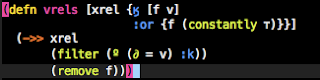
The following image is what the same function looks like with custom font locks applied. It might be a bit jarring at first, but in the long run it should add up to many small victories such as quickly identifying patterns in code and less line breaks.
I wrote the following unix to give me a rough idea of what we type frequently.
find . -name "*.clj" | xargs cat | tr -s '[:space:]:#()[]{}\"' '\n' | sort | uniq -c | sort -nnote: If you're not writing clojure you'll want to look for something other than .clj files, and you might also want to tweak what you replace with a new line.
The above unix gave me an ordered list of the most typed 'words' across all of my codebases. At this point I had some science for setting up some shortcuts.
Writing
You'll want to look into whatever editor/ide you use and see if you can find key shortcuts and snippet expansion. My editor is emacs; I assigned some key-chords and some yasnippets. If you're not using emacs you should have something similar in whatever you are using.While I wanted to define some shortcuts, I also didn't want to create so many that I was constantly wasting time looking up what I'd created. Based on that desire I created:
- 2 shortcuts (key-chords) for two of the most duplicated words. The shortcuts are concise by design, but that makes them a bit harder to remember. You can probably get started with more than 2, but I didn't see much harm in starting there.
- a dozen snippets for the next most used words. These snippets are descriptive enough to easily remember, thus I felt comfortable defining several of them. e.g. pps expands to (println (pr-str )).
Reading
Most editors/ides also give you a summary view for common code patterns. For example, IntelliJ displays lambdas when the actual code is actually an anonymous class. Emacs gives you font-lock for turning patterns into individual characters. Armed with my list of the most common words in my codebase, I created font-locks for the 11 most duplicated.Sometimes a picture is worth a thousand words. Below is a function definition without any font locks applied.

The following image is what the same function looks like with custom font locks applied. It might be a bit jarring at first, but in the long run it should add up to many small victories such as quickly identifying patterns in code and less line breaks.

Results
I've been working with these settings for a little over a week now. I haven't needed to look up anything I defined, and I get a little burst of satisfaction when I read or write something faster than I'd been able to in the past. I'd definitely recommend doing something similar with your codebase and ide/editor.
Subscribe to:
Posts (Atom)